
This guide will walk you through how to start a Shopify store from scratch — covering everything from initial planning, store setup, product selection, and branding, all the way to marketing and scaling. Whether you’re looking to launch a side hustle, build a full-time e-commerce business, or take your existing store online, these steps will help you start strong and grow steadily.
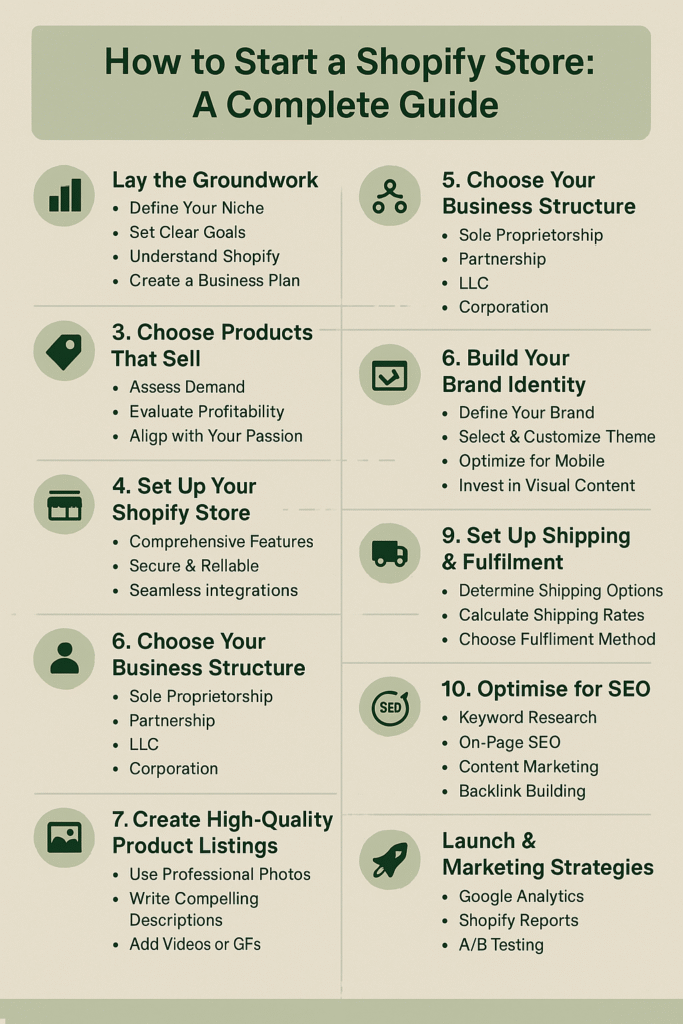
Step 1: Lay the Groundwork
Before rushing into store creation, it’s important to prepare a strong foundation.
1.1 Define Your Niche
Choose a niche that aligns with your interests and expertise but also has proven market demand. Evaluate profitability, competition, and long-term sustainability.
(Need help validating your niche? Our Shopify Store Setup team can guide you.)
1.2 Set Clear Goals
Know whether you’re aiming for passive income, a full-scale brand, or industry leadership. Clear objectives help guide every decision you make.
1.3 Understand Shopify’s Features & Pricing
Explore Shopify’s plans, features, and tools. Use the free trial to test its inventory management, payment gateways, and marketing tools before committing.
1.4 Create a Business Plan
Outline your objectives, target audience, marketing strategy, and financial projections. A business plan isn’t just for investors — it keeps you accountable.
Step 2: Identify Your Audience
Your customers dictate your store’s success. Know who they are and how to speak to them.
2.1 Conduct Market Research
Use Google Trends, social media analytics, and SEO tools to spot trends, demand gaps, and buying habits.
2.2 Build Buyer Personas
Create detailed profiles of your ideal customers, including age, gender, income, hobbies, and pain points.
2.3 Analyse Competitors
Study competitors’ pricing, marketing, reviews, and product selection to spot opportunities and craft your Unique Selling Proposition (USP).
Step 3: Choose Products That Sell
3.1 Assess Demand
Pick products with consistent demand and manageable competition.
3.2 Evaluate Profitability
Calculate margins, shipping costs, and overhead. Aim for products that offer healthy profits.
3.3 Align with Your Passion
When you sell something you care about, your brand voice becomes more authentic — which boosts customer trust.
Step 4: Set Up Your Shopify Store
Shopify makes store creation simple with its intuitive interface.
4.1 Comprehensive Features
From inventory management to analytics, Shopify equips you with all the tools to run your store efficiently.
4.2 Secure & Reliable
Built-in SSL and PCI compliance ensure secure transactions.
4.3 Seamless Integrations
Connect with third-party tools for email marketing, shipping, or accounting.
Step 5: Choose Your Business Structure
Select the structure that best suits your goals:
-
Sole Proprietorship – Simple setup, but personal liability.
-
Partnership – Share resources and responsibilities.
-
LLC – Limits liability and offers flexibility.
-
Corporation – Maximum protection, more complex compliance.
Step 6: Build Your Brand Identity
6.1 Define Your Brand
Identify your values, mission, and tone.
6.2 Select & Customise Your Theme
Pick a Shopify theme that reflects your brand, then adjust colors, fonts, and layouts.
6.3 Optimise for Mobile
Ensure your design works flawlessly on smartphones and tablets.
6.4 Invest in Visual Content
Professional photos and videos make your store look trustworthy and premium.
(Our Shopify Development Services team can help create a pixel-perfect, on-brand store.)
Step 7: Create High-Quality Product Listings
-
Use professional photos with multiple angles and lifestyle shots.
-
Write compelling descriptions focusing on benefits and solutions.
-
Add videos or GIFs to boost engagement.
Step 8: Simplify Payments & Checkout
-
Offer multiple payment options (credit card, PayPal, Apple Pay).
-
Enable guest checkout to reduce friction.
-
Consider one-click checkout for repeat buyers.
Step 9: Set Up Shipping & Fulfilment
-
Offer multiple shipping speeds and costs.
-
Use Shopify’s shipping calculator for accurate rates.
-
Choose dropshipping, in-house fulfilment, or 3PL — whichever fits your growth model.
Step 10: Optimise for SEO
10.1 Keyword Research
Target product-specific and long-tail keywords like “how to start a Shopify store for handmade jewellery”.
10.2 On-Page SEO
Optimise meta titles, descriptions, headings, and image alt tags.
(Learn more about our Shopify SEO Services here.)
10.3 Content Marketing
Publish blogs, guides, and tutorials that address your audience’s needs.
10.4 Backlink Building
Earn links from reputable sources to boost your domain authority.
Step 11: Track Performance with Analytics
-
Google Analytics – Track traffic, behaviour, and conversions.
-
Shopify Reports – Monitor sales, inventory, and customer behaviour.
-
A/B Testing – Test variations of pages, CTAs, and pricing.
Pre-Launch Checklist
-
Test your website across devices.
-
Compress images for fast load times.
-
Double-check product details.
-
Set up customer support (live chat, email).
Launch & Marketing Strategies
-
Social Media Marketing – Share product teasers, behind-the-scenes, and launch offers.
-
Influencer Collaborations – Partner with creators in your niche.
-
Email Marketing – Send segmented campaigns for higher engagement.
-
Paid Advertising – Use Google Ads, Facebook Ads, or Pinterest Ads for targeted traffic.
Why Choose Kolachi Tech to Launch Your Shopify Store?
At Kolachi Tech, we specialise in building high-converting, fully optimised Shopify stores. Whether you need Shopify Store Setup, Custom Shopify Development, or Shopify Migration, our team ensures your store looks stunning, runs smoothly, and ranks well in search results.
We provide:
-
Expert guidance from niche selection to launch.
-
Custom solutions tailored to your brand.
-
Ongoing support to keep your store updated and secure.
Conclusion
Launching a Shopify store isn’t just about going live — it’s about planning, optimising, and marketing it for long-term growth. Follow these steps, keep learning, and adapt your strategies as you go.
And if you want expert help setting up your store for success from day one, Kolachi Tech is here to make it happen.
